
10 Reasons to Make This Your Recovery Month
Recovery Month is recognized every September in Canada and the United States as a way to raise awareness about substance use disorders and the reality of recovery. But the truth is, recovery doesn’t need a calendar.
If you’ve been thinking about change—even quietly, even for a long time—this can be your moment to begin. Not from shame or fear, but from a desire to come back to yourself. Recovery is not about being “strong enough.” It’s about getting support, building steadiness, and taking one step at a time toward a life that feels more manageable.
10 Reasons to Focus on Your Recovery
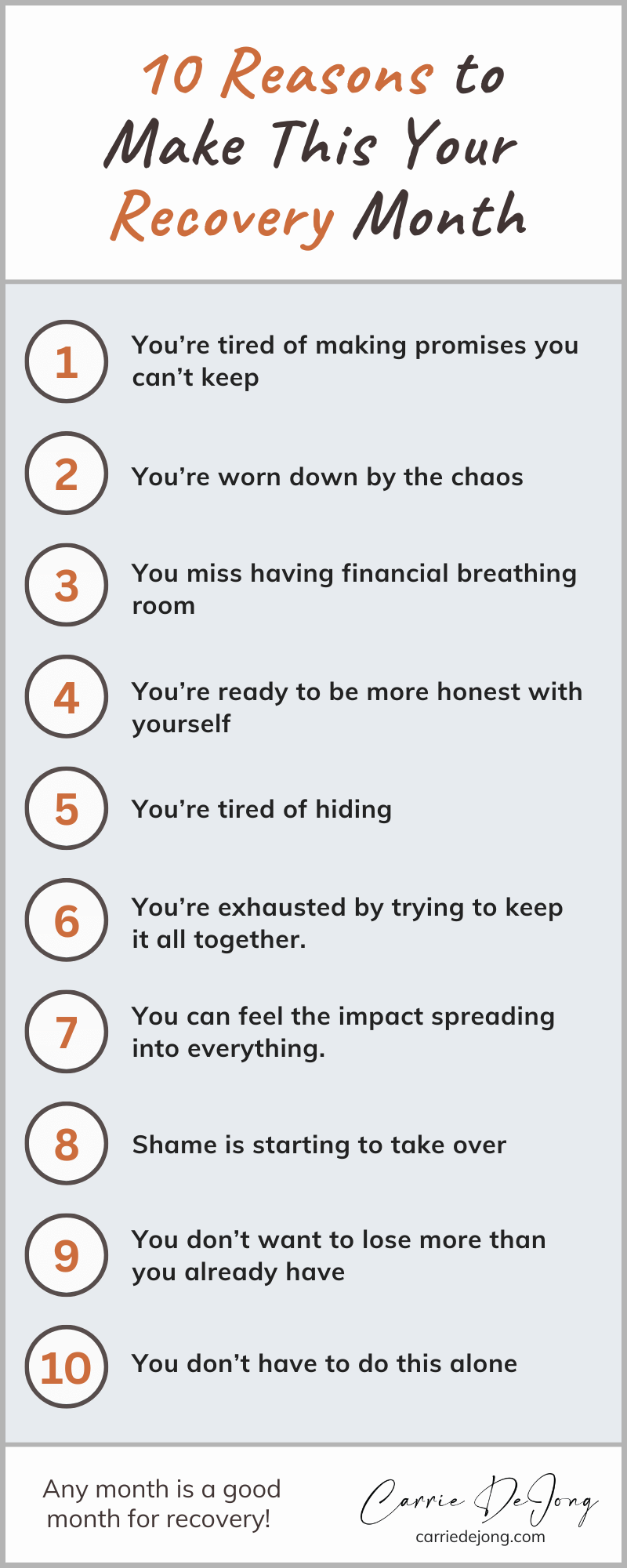
1. You’re tired of making promises you can’t keep
Maybe you’ve promised yourself you’ll cut down. Stop. Take a break. Get help.
If you’re exhausted by the cycle of intentions and regret, it might be time to try something different—not by pushing harder, but by getting support.
2. You’re worn down by the chaos
Addiction rarely appears as a single dramatic event. More often, it manifests as a series of small crises: lost time, missed calls, forgotten plans, financial issues, and emotional fallout. If your life feels increasingly chaotic, your nervous system might be signaling that it can’t handle this anymore.
3. You miss having financial breathing room
Substance use is expensive. And the cost is rarely just the substance itself—it’s the ripple effect: impulsive spending, missed work, recovery days, damaged opportunities.
Recovery can become a turning point where your money starts supporting your life again.
4. You’re ready to be more honest—with yourself
Many people minimize their substance use because it feels safer than facing it.
“I only drink on weekends.”
“I can stop anytime.”
“I’m not as bad as other people.”
These are often coping strategies, even when they’re no longer working. But honesty is often the first real doorway to change.
5. You’re tired of hiding
Most people struggling with substance use keep secrets. How much they're using. What it costs. How often they’re hungover. What they said or did. Why they didn’t show up.
Secrecy doesn’t mean you’re bad—it usually means you’re uncomfortable with people knowing the truth.
6. You’re exhausted by the emotional labor of keeping it together
Addiction is not only physically draining, but also mentally and emotionally exhausting.
The constant tracking, managing, covering, recovering, and trying to appear “fine” takes a significant toll.
7. You can feel the impact spreading into everything
Substance use doesn’t stay contained. It impacts relationships, motivation, health, confidence, work, parenting, intimacy, and your sense of identity. If you feel like you’re losing parts of yourself, recovery can be a starting point to rebuild.
8. Shame is starting to take over
Shame is one of the strongest fuels for addiction. It’s the voice that asks, “What’s wrong with me?” and then pushes you to numb the pain of that question. Recovery helps break that cycle—not by demanding perfection, but by offering support and compassion where shame has been running the show.
9. You don’t want to lose more than you already have
Some losses are obvious. Others are more subtle: your energy, your hope, your peace, your ability to feel proud of yourself. Recovery isn’t about punishment. It’s about protecting what matters before more is taken.
10. You don’t have to do this alone
Recovery is real, and it’s more common than most people realize.
There are programs, professionals, groups, communities, and supports that exist specifically because this struggle is human—and because healing is possible.
Before you go
If any part of this post resonates, let it be an invitation—not a verdict. Substance use is rarely driven by a love of intoxication. More often, it’s an attempt to cope with stress, pain, trauma, loneliness, or overwhelm.
You don’t need to hit rock bottom to deserve support. You don’t need to be “ready” in a perfect way. You only need a starting point. Recovery can start with one honest moment, one conversation, and one step toward help.
Continue Exploring
Understanding the challenges of changing drinking habits.
Practical approaches that support recovery and regulation.
Why nervous system regulation can take time.