
Why the Same Body Signal Can Mean Different Things
This article looks at how context, experience, and interpretation shape emotional experiences.

Many people assume that each emotion has a distinct set of physical sensations. Fear might feel a certain way, excitement another, and calm something completely different.
However, the body does not always work this way. In many cases, the same physical signals can occur during different emotional experiences.
A faster heartbeat, changes in breathing, stomach tension, or a rush of energy can happen when we feel anxious, excited, determined, or physically active. These sensations show how the body is reacting to a situation, but they do not automatically correspond to a single emotion.
What often shapes the emotional experience is not just the body signal, but how that signal is interpreted within the context of what is happening around us.
Understanding this can make emotional experiences seem less mysterious and help clarify why bodily sensations sometimes feel confusing.
The Body Produces General Signals
The body constantly adapts to the demands of daily life. As we move, think, interact, and respond to events, internal systems adjust heart rate, breathing, muscle readiness, digestion, and energy levels.
Many signals we notice through interoception reflect these overall shifts in activation rather than a particular emotion.
For example, the body may increase heart rate and breathing when preparing for action. Muscles may tighten slightly as attention sharpens and the body becomes ready to respond.
These changes can happen in many situations—during exercise, while preparing for a challenging task, when facing something unexpected, or when expecting an important moment.
Because these signals are general indicators of the body’s condition, they can influence a variety of emotional experiences.
The Brain Interprets the Signal
Body signals are just one aspect of the emotional experience. The brain also interprets those signals based on what's happening in the environment.
To make sense of internal sensations, the brain considers factors such as:
the current situation
past experiences
expectations
social context
what has happened in similar moments before
Together, these factors help shape the emotional meaning of a body signal.
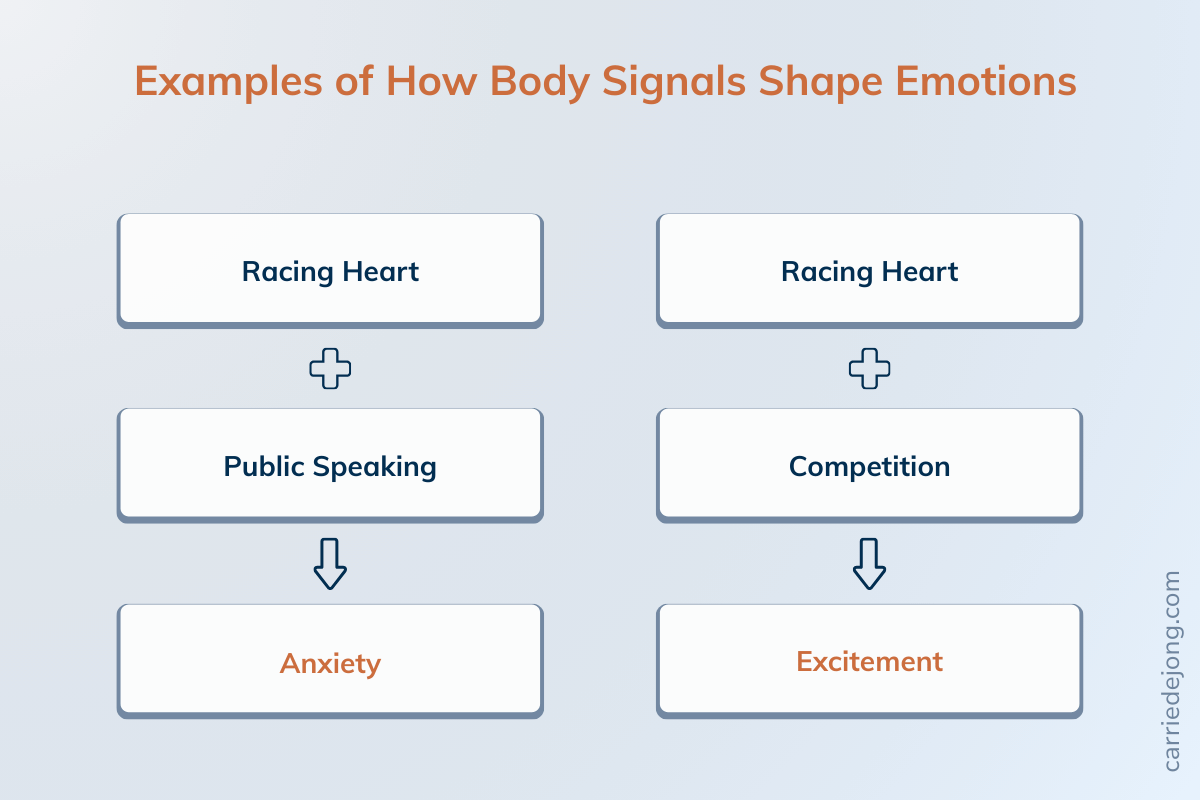
A racing heart during a competition might be experienced as excitement. The same sensation before speaking in front of an audience might be experienced as anxiety. During exercise, it may simply be recognized as physical exertion.
In each case, the bodily signal is similar, but the context helps shape how it is understood.
Everyday Examples
This pattern appears in many ordinary experiences.
Butterflies in the stomach
The fluttering sensation, often called “butterflies,” can happen before giving a speech, going on a first date, or starting something important.
In one instance, it may feel like nervousness. In another, it may feel like excitement.
A faster heartbeat
A quickened heartbeat may occur during physical exercise, a tense conversation, or anticipation of something significant.
The body responds with increased energy and alertness. How that feeling is interpreted influences whether the experience feels like fear, excitement, or determination.
Tightness in the chest
A tightening in the chest may appear during stress, anger, anticipation, or intense focus.
The physical sensation might be similar, but the emotional meaning can differ based on the situation and the person’s interpretation of what's happening.
How the Brain Makes Predictions
The brain doesn't interpret body signals from scratch every time they happen. Instead, it relies heavily on past experiences to predict what those signals could mean.
Based on past experiences, memories, and expectations, the brain constantly makes predictions about what is occurring in the body and surroundings. These predictions assist the brain in interpreting internal sensations more rapidly and effectively.
For example, if someone often feels a racing heart before stressful events, the brain might start to associate that sensation with anxiety. When the same bodily signal occurs again, the brain might quickly interpret it as a sign of worry or danger.
In other situations, the same racing heart might be associated with excitement, competition, or physical activity.
These predictions are not errors—they are the brain’s method of interpreting complex information as efficiently as possible. But they can also influence how emotional experiences develop.
Research Insight
Research in neuroscience suggests that the brain constantly combines signals from the body with expectations based on past experiences. This process helps people quickly interpret internal sensations and respond to changing situations.
Because of this, the same bodily signals can lead to different emotional experiences depending on the context and the expectations the brain has in that moment.
When Misinterpretation Happens
Sometimes body signals can be misinterpreted, especially when internal sensations feel unfamiliar or difficult to understand.
For example, someone noticing a rapid heartbeat might assume that something is wrong with their body, when the sensation simply reflects normal stress or anticipation.
When this happens, attention may become increasingly focused on the sensation, amplifying worry and making the experience feel more intense.
Situations like these can make bodily signals feel confusing or alarming, even when the body is functioning normally.
Interoception and Emotional Clarity
Developing greater awareness of internal signals can help people recognize patterns in how emotions appear in the body.
Over time, noticing shifts in breathing, muscle tension, or energy levels can make it easier to recognize emotional changes as they arise.
This does not require constant monitoring of the body. Rather, it involves gradually becoming more familiar with how the body tends to respond in different situations.
As this familiarity grows, emotional experiences often become easier to understand.
Listening to Body Signals with Curiosity
Body signals do not always correspond to a single emotion. Instead, they provide information about how the body is responding in the moment.
Learning to notice these signals with curiosity—rather than immediately judging or reacting to them—can help people better understand their emotional experiences.
Over time, this process can strengthen the connection between bodily awareness and emotional understanding.
In this way, emotions can be seen as part of an ongoing conversation between the brain and the body.
Continue Exploring
How bodily sensations help create emotions.
Why internal signals can feel confusing, overwhelming, or unclear.
Explore your patterns of noticing, understanding, and relating to internal signals.
Practices to help you notice, understand, and respond to your body’s signals.