
Body Signals Shape Emotions
Many people think of emotions as something that happens primarily in the mind—thoughts, reactions, or interpretations of events.
Yet emotions are also deeply connected to the body. Changes in breathing, heart rate, muscle tension, and other internal signals contribute to how emotions arise and how they are experienced.

These signals are part of a process known as interoception—the ongoing communication between the brain and the body that allows us to sense and interpret what is happening inside us.
Although we often think of emotions as psychological experiences, they are also shaped by the body’s internal signals. Understanding this connection can explain why emotions sometimes feel clear and easy to identify, while at other times they seem confusing or hard to interpret.
The Body Is Always Sending Signals
The body constantly generating information about its internal state. Changes in heart rate, breathing, temperature, muscle tension, digestion, and other processes give signals about how the body is reacting to what is happening around us.
The brain continually receives and interprets these signals, often outside of conscious awareness. Most of the time, this process happens automatically.
When we start to feel tired, for example, the body may send signals such as muscle heaviness or lower energy levels. Hunger might be accompanied by stomach sensations. Stress could appear as changes in breathing or tension in the shoulders.
These signals do not simply reflect what we feel—they also help shape emotional experience.
How Body Signals Contribute to Emotional Experience
Emotions emerge through an ongoing interaction between the body and the brain. Internal signals provide information about the body’s state, while the brain interprets them in the context of what is happening in the environment.
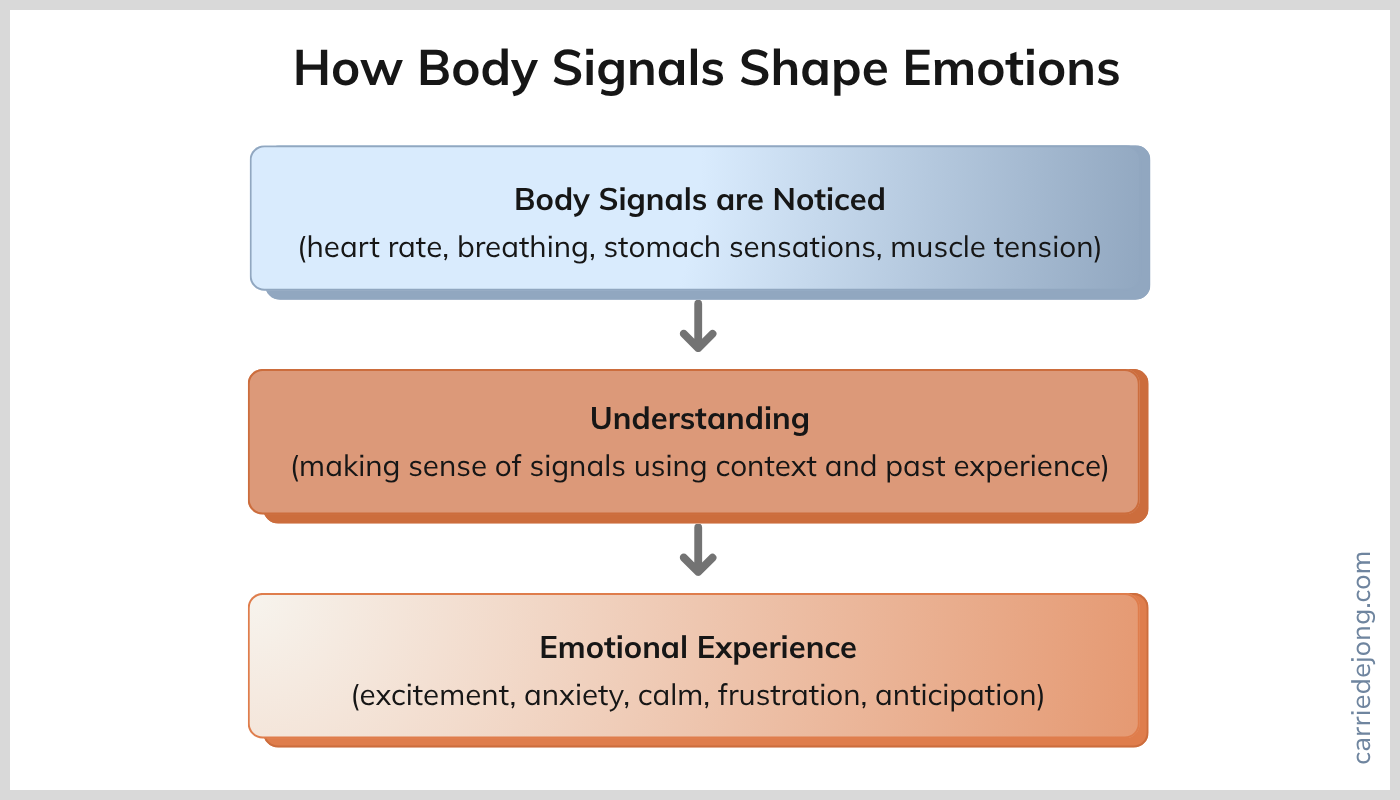
In simplified form, the process often looks something like this:
Body signals → interpretation → emotional experience
For example, changes in heart rate, breathing, and muscle tension might occur when preparing to give a presentation. These same signals could contribute to feelings of nervousness, anticipation, or excitement.
Bodily sensations alone are not always tied to a single emotion. Instead, they become part of an emotional experience as the brain interprets them within a context.
In this way, emotions are shaped not only by our thoughts or circumstances but also by the body’s internal signals.
In simplified form, the process often looks something like this:
Research Insight
Research in neuroscience and psychology suggests that emotions are closely linked to signals from the body. Changes in heart rate, breathing, muscle tension, and other internal processes provide information that the brain uses to interpret what we are experiencing.
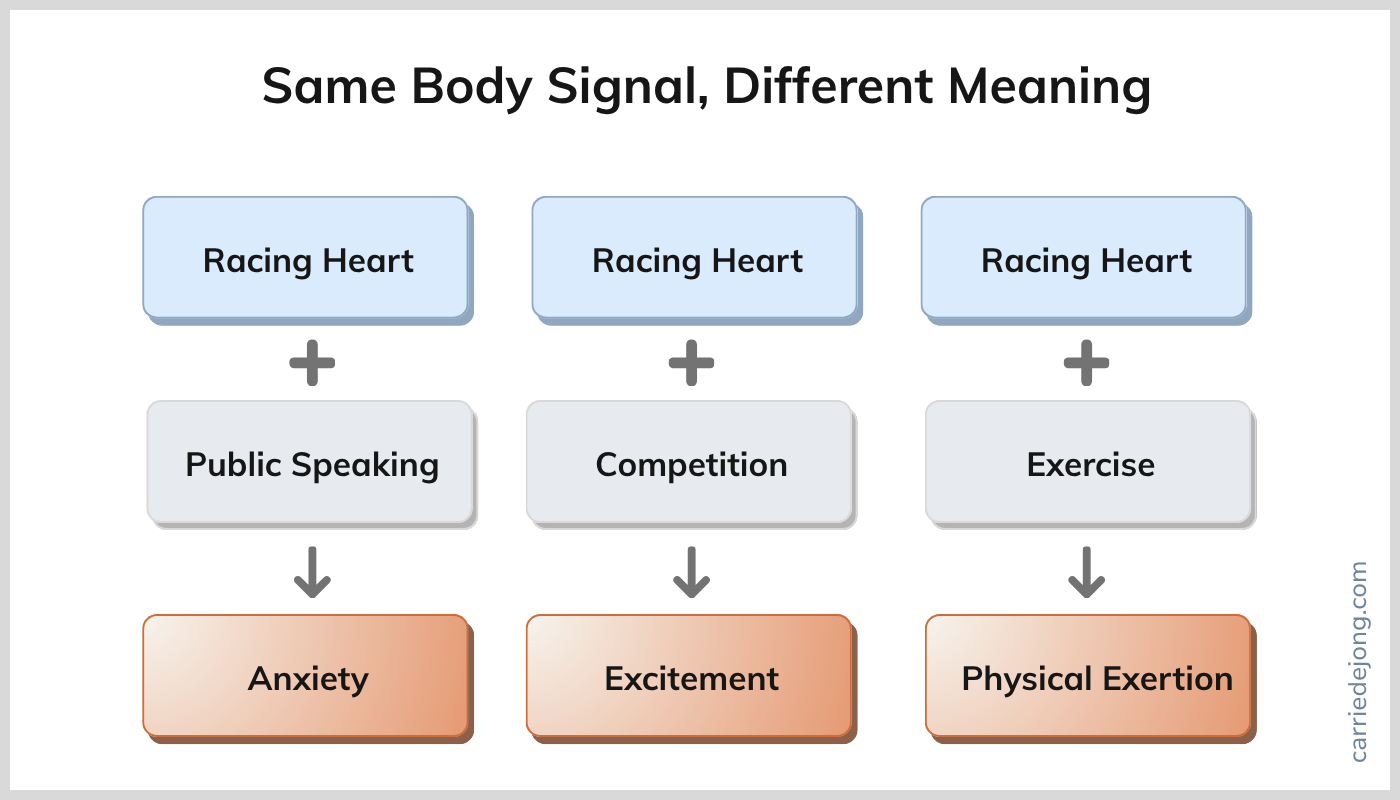
For example, physical sensations like a faster heartbeat and increased energy might lead to feelings of excitement in one situation and anxiety in another. The bodily signals are similar, but the context and how we interpret them shape the emotional experience.
Why the Same Body Signal Can Feel Like Different Emotions
One interesting aspect of interoception is that the same bodily sensation can elicit different emotional experiences depending on the situation.
A fluttering sensation in the stomach might appear before giving a speech, meeting someone new, or starting an important project. In one situation, it might be experienced as anxiety, while in another, it may feel like excitement.
Similarly, a faster heartbeat can occur with physical activity, anticipation, fear, or enthusiasm. The sensation itself may be similar, but the meaning we give to it can differ depending on context.
Because of this, emotions are not generated solely by the body or the mind. Instead, they arise from the continuous interaction between physical signals, interpretation, and experience.
Interoception and Emotional Awareness
The ability to notice and interpret internal signals plays an important role in emotional awareness.
When people are able to sense subtle shifts in breathing, muscle tension, or other bodily signals, they may recognize emotional changes earlier. For example, noticing tension in the jaw or shoulders might signal rising frustration, while a sense of warmth or ease in the body might signal safety or connection.
This awareness doesn't require constant body monitoring. Instead, it involves a general understanding of the body’s signals and their connection to emotional experiences.
For some people, these signals are naturally easy to notice. For others, they may be less clear or require more attention to recognize.
Research Insight
Research also shows that people vary in how clearly they notice and interpret the body’s internal signals. Some individuals easily recognize subtle changes in breathing, tension, or energy levels, while others may only notice these signals when they become more pronounced.
These differences in interoceptive awareness can influence how people recognize emotions and respond to stress.
When Interoception Is Altered
At times, the connection between body signals and emotional awareness can become less clear.
When internal signals are difficult to perceive or interpret, emotions may feel confusing or harder to identify. A person may experience physical tension without immediately recognizing it as stress, or feel unsettled without being able to clearly identify the underlying emotion.
Experiences such as chronic stress, trauma, or long periods of ignoring the body’s signals can influence how clearly internal sensations are perceived.
When this happens, emotional experiences may feel overwhelming, muted, or difficult to interpret.
You can read more about this process in When Interoception Becomes Altered.
Learning to Notice Emotional Signals in the Body
Becoming more aware of how emotions appear in the body does not require intense focus or analysis. Often it begins with simple curiosity.
Small moments of attention—such as noticing changes in breathing, tension, posture, or energy levels—can gradually increase awareness of how internal signals relate to emotional experience.
Over time, these small observations can help people recognize emotional shifts earlier and respond to them with greater understanding.
Rather than trying to control emotions, this process involves learning to listen more carefully to the body’s signals.
Emotions as an Ongoing Conversation Between Brain and Body
Emotions are more than just thoughts or reactions to events. They are experiences that emerge through continuous interaction between the brain and the body.
Internal signals from the heart, lungs, gut, muscles, and other systems contribute to how emotions arise and how they are understood.
By learning to notice these signals with curiosity and patience, it becomes possible to develop a deeper understanding of emotional experience—and a greater sense of connection to the body’s messages.
Continue Exploring
Interoception is the sense that helps us notice bodily signals.
How bodily awareness shapes well-being and emotional balance.
Why the brain interprets the same sensation in different ways.
Explore simple practices that help strengthen awareness of bodily cues.