
What Is Interoception?
Much of our inner life happens without words.
Before we label something as anxiety, excitement, hunger, or fatigue, subtle signals are already moving through the body. A flutter in the chest. A tightening in the stomach. A wave of warmth. A heaviness behind the eyes.
Interoception is the sense that allows us to notice and interpret these internal signals.

It is how we perceive what happens inside the body — heartbeat, breathing, muscle tension, temperature, digestion, and the shifting chemistry of stress and emotion. These signals travel through sensory pathways and the autonomic nervous system to the brain, where they are interpreted and given meaning.
In simple terms: Interoception is how we “listen” to our body from the inside.
Why Most People Haven’t Heard of It
We learn about the five senses — sight, sound, smell, taste, and touch. Some might even know the additional senses, like our sense of balance (vestibular) and our awareness of body movement and position (proprioception). But even fewer have heard of interoception.
Interoception is sometimes called the “eighth sense,” yet it is rarely discussed outside of neuroscience or specialized clinical training.
And yet it shapes nearly everything:
How we recognize emotions
How we regulate stress
How we know when to rest or push through something
How safe or unsafe we feel
How we experience hunger, fullness, or craving
How we sense connection or disconnection
Without realizing it, we rely on interoception every day.
How Interoception Works
The body is constantly sending signals to the brain.
Signals from the body—such as heart rate, breathing, and muscle tension—are continuously sent to the brain, where they are interpreted and help guide how we feel and respond.
You might notice this when:
Your heart rate increases before speaking in public
Your stomach tightens when you feel uncertain
Your shoulders relax when you feel safe or supported
These signals are part of the body’s ongoing communication with the brain.
Over time, the brain uses this information to make predictions about safety, effort, and emotional meaning. Much of this process happens automatically, shaping how we experience the world.
Interoception and Emotion
Emotions are more than just thoughts. They are physical experiences we feel in our bodies.
When someone says, “I feel anxious,” what they often mean is:
My heart is racing.
My breathing feels shallow.
My chest feels tight.
My stomach feels unsettled.
These bodily sensations are the raw data of emotion.
Research suggests that our ability to recognize and regulate emotions is closely tied to how clearly and accurately we perceive internal signals. When interoceptive awareness is steady and flexible, emotions tend to feel more understandable and manageable. When it is disrupted — by chronic stress, trauma, illness, or long-standing coping patterns — emotions can feel confusing, overwhelming, or distant.
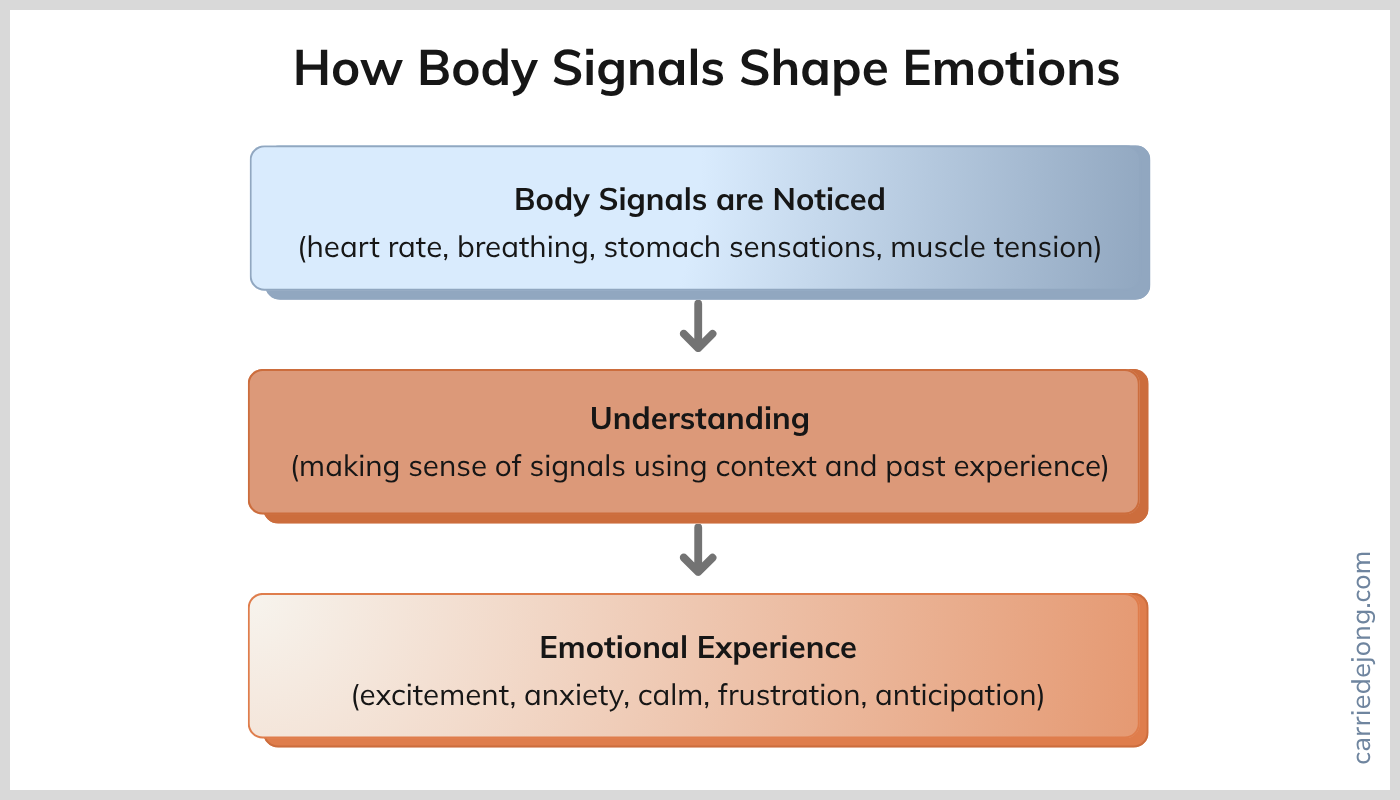
You can explore this further here:
How Body Signals Shape Emotions.
Interoception and the Nervous System
Interoception is closely linked to the autonomic nervous system — the system that automatically regulates heart rate, digestion, breathing, and stress responses.
When we are calm, internal signals tend to be steady and predictable. When we feel stressed or threatened, these signals change: heart rate rises, muscles tense, and digestion slows.
Over time, the brain uses these signals to predict safety or danger, shaping how we feel in different situations—sometimes based on past experience rather than current reality.
For example, imagine preparing for something meaningful — a presentation, a first date, or the start of a new project. Your heart beats faster. Your palms feel warm. Your breathing changes. These sensations could signal excitement. But if similar bodily cues have previously been associated with stress or embarrassment, the brain may interpret them as anxiety instead. The body’s activation is real — but the meaning assigned to it can differ.
This is one reason why patterns can repeat; the body might respond before the brain fully understands why.
Why Interoception Matters
Interoception plays an important role in many aspects of mental and physical well-being.
Research suggests it is closely connected to:
Emotional awareness
Stress regulation
Decision-making
Self-awareness
Strengthening awareness of these signals can support regulation, resilience, and a greater sense of connection to oneself.
Learn more about why interoception matters for emotional and mental health.
When Interoception Becomes Disrupted
Interoception isn't simply labeled as "good” or "bad"; it can differ in quality.
Some people experience internal signals very intensely and may feel easily overwhelmed.
Others feel very little; signals might seem muted or distant. Hunger can go unnoticed. Fatigue might be ignored. Emotions often feel vague or difficult to identify.
Both patterns are common in lives impacted by chronic stress, trauma, or addiction. The body adapts to survive. Sometimes that adaptation involves strengthening signals. Other times, it involves weakening them.
Understanding this can change how we see many challenges. What looks like a lack of motivation, overreaction, or emotional shutdown might actually be differences in how internal signals are sensed and interpreted.
A Simple Practice to Begin
Pause for a moment. Without trying to change anything, notice:
Your breathing.
The contact of your body with the chair or floor.
Any areas of warmth, tension, or ease.
There is no need to analyze or judge. Just notice.
This is the beginning of interoceptive awareness.
Learning to Listen In
Much of modern life pulls our attention outward — toward screens, tasks, demands, and noise. Interoception invites us to turn attention inward—not to escape, but to gain information.
When we learn to listen to internal signals with steadiness and curiosity, we begin to recognize patterns. We notice what activates us, what calms us, and what signals hunger, fatigue, or emotional strain.
Over time, this inner listening can serve as a foundation for regulation, resilience, and well-being.
Healing does not begin by overriding the body.
It often begins by learning to listen.
If you’d like to explore how interoception shows up in daily life, you can read more in the Understanding Interoception section, where we look at how internal awareness shapes stress, trauma, addiction, and emotional well-being.
You can also explore practical ways to strengthen interoceptive awareness in the Practices section.
Prefer to Watch Instead?
If you would like a short introduction to this idea, watch my TEDx talk on interoception, where I explore how learning to listen to internal signals can influence emotional well-being and self-understanding.
Curious About Your Own Interoceptive Awareness?
Interoception has many dimensions — including noticing bodily sensations, trusting internal signals, and staying present with physical discomfort.
The MAIA (Multidimensional Assessment of Interoceptive Awareness) is a research-based self-reflection tool that explores these different aspects of inner awareness.
If you’re interested, you can take the assessment and learn more about your own interoceptive profile.